


Published
5 minute read
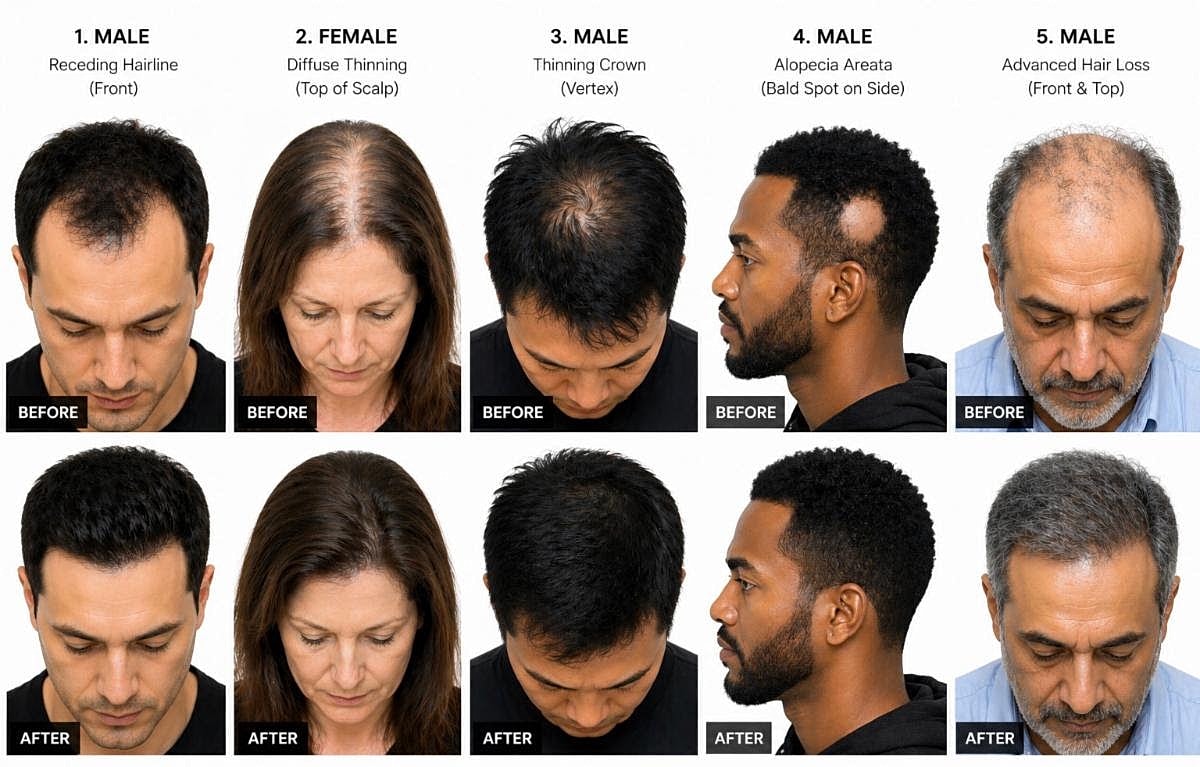
The most important hair you can restore may be the hair you haven't lost yet.
One of the biggest misconceptions I see in hair restoration is the belief that treatment begins when you've lost enough hair to need a transplant.
I believe it should begin long before that. And if you've already had a hair transplant, treatment certainly shouldn't end once the grafts have been placed.
Hair loss is usually an ongoing process. A transplant can move healthy follicles into areas where hair has been lost, but it does not necessarily stop the surrounding, non-transplanted hair from continuing to thin. That's why, at Youthful Images, we approach hair restoration differently.
Our first goal is preservation. Our second is restoration.
I often tell patients to think about their scalp in much the same way they think about the skin on their face. We don't wait until our skin has significantly aged before caring for it. We cleanse it. We protect it. We use appropriate topical products. We may perform microneedling or other treatments to stimulate and maintain the skin.
Why shouldn't we take the same approach to our scalp and hair?
That's the philosophy behind our tiered Youthful Images Hair Restoration Program.
Whenever appropriate, I prefer to begin with the simplest approach.
Our first level is a home-based topical hair and scalp program designed to support the existing hair and scalp without automatically beginning with medications such as minoxidil or finasteride.
The objective is straightforward:
Create the healthiest possible environment for the follicles you still have.
Consistency is critical. Hair maintenance isn't something you do for a few weeks and then forget about. Just as with skincare, meaningful improvement and preservation require an ongoing commitment. We may complement the home program with monthly scalp microneedling. Most people are familiar with microneedling for facial rejuvenation. The principle of controlled stimulation can also be applied to the scalp as part of a comprehensive hair-restoration program. For some patients, this foundational level may be all that is necessary initially. For others, we move to the next level.
When greater stimulation is appropriate, we can incorporate an advanced platelet-based treatment using a fibrin matrix. This is an important distinction from conventional platelet-rich plasma treatment. With traditional PRP, concentrated platelets are injected into the scalp. Our fibrin-matrix approach is designed to create a scaffold that retains platelets and their associated growth factors within the treatment area for a more sustained period rather than relying upon a simple liquid PRP injection. The goal is to provide prolonged interaction within the tissue surrounding the follicles. Again, we're still working toward the same objective:
Protect, strengthen and support the follicles that are already there.
This treatment can become part of an ongoing maintenance strategy, whether or not a patient ultimately requires transplantation.
There comes a point when stimulating existing follicles may not be enough.
If follicles have been permanently lost, we then evaluate whether Follicular Unit Extraction (FUE) is appropriate. With FUE, individual follicular units are carefully harvested from appropriate donor areas and strategically transplanted into areas where additional hair is needed. This allows us to address areas of established hair loss while designing a natural-looking hairline and distribution pattern. But there is something extremely important to understand:
A hair transplant does not eliminate the need for hair maintenance.
The transplanted follicles may continue to grow, while the patient's original surrounding hair can continue its natural pattern of thinning. Imagine restoring a thinning hairline beautifully but doing nothing to protect the hair immediately behind it. Years later, the transplanted hair could remain while the untreated native hair continues to disappear. That is exactly what we're trying to prevent.
Our approach can therefore be summarized very simply:
1. Preserve the hair you have.
Begin with an appropriate home scalp and hair program and ongoing maintenance.
2. Stimulate follicles that can still respond.
Add treatments such as microneedling and advanced platelet-based therapy when appropriate.
3. Replace hair where follicles have already been lost.
Consider FUE transplantation when examination shows that restoration—not simply stimulation—is needed.
4. Continue maintenance for life.
Protect both your existing hair and the overall appearance of your transplanted result. That final step may be the most important one.
I've been involved in aesthetic medicine for many years, and one lesson applies again and again:
Maintenance is easier than replacement.
We understand this when caring for our skin, our teeth, our physical fitness and almost every other part of our bodies. Your hair should be no different. Whether you're just beginning to notice thinning, actively losing hair, or have already undergone a hair transplant, the question shouldn't simply be:
“How do I replace the hair I've lost?”
A better question is:
“What can I do now to preserve the hair I still have?”
That's where our hair-restoration evaluation begins. At Youthful Images, we'll examine your existing hair, your pattern of loss, your donor area and your goals, and then determine which level of treatment is appropriate for you today—and how we can protect your hair for the future. Your hair deserves a long-term plan.
If you'd like us to evaluate yours, contact Youthful Images to schedule a personalized hair-restoration consultation.
Youthful Images
Plastic Surgery • MedSpa • Hair Restoration